






If you follow global HR headlines, you would think the biggest challenge facing organizations today is artificial intelligence: how fast it is moving, how many jobs it will displace, and whether companies can keep up. That narrative is everywhere. And while it is not exactly wrong, it is not all that is keeping business leaders up at night.
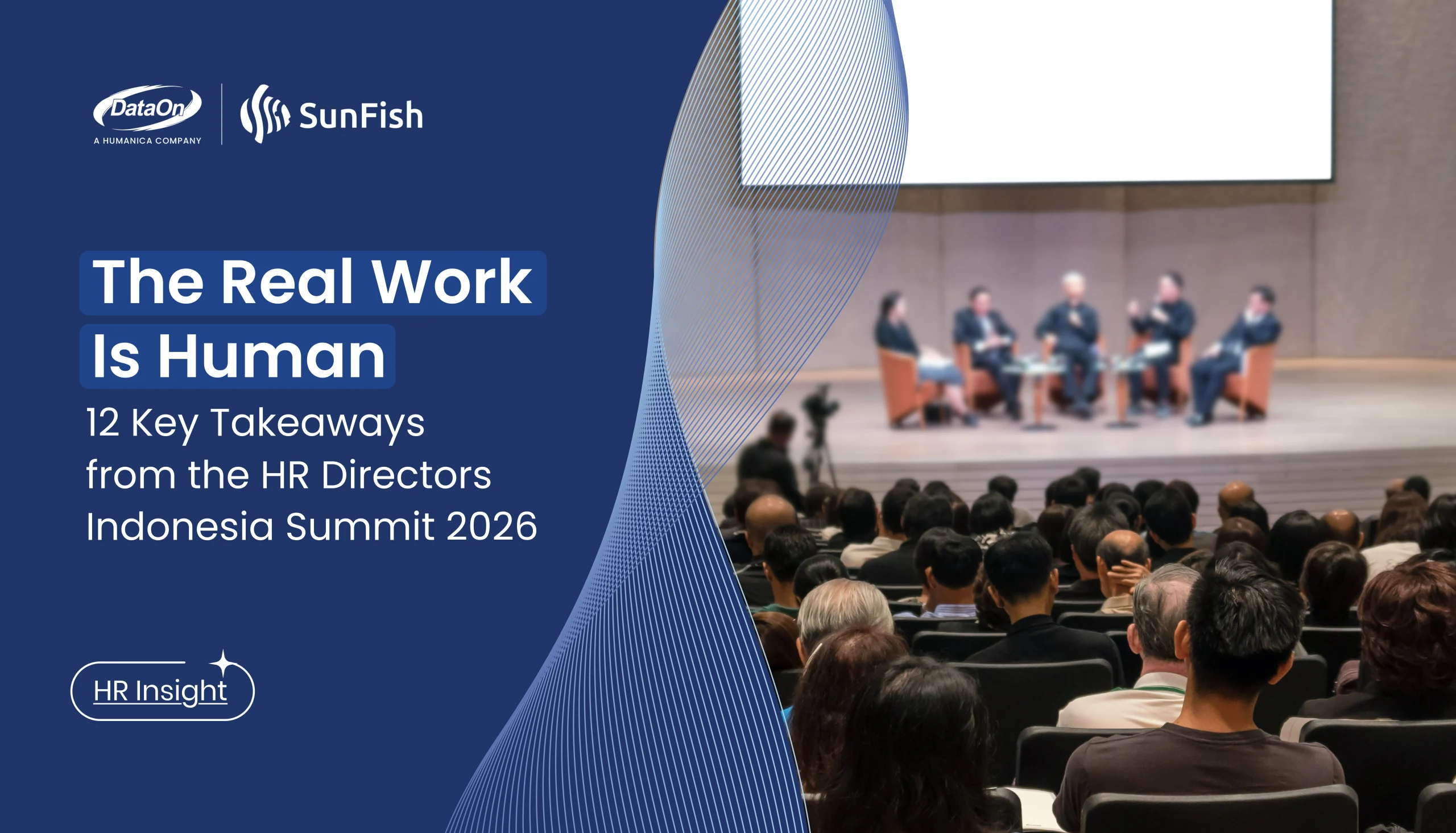
Those, following our updates, know that at the end of April, DataOn had the opportunity to be part of HR Directors Indonesia Summit 2026. During those two days, across twelve panel discussions led by practitioners from banking, mining, healthcare, FMCG, technology, hospitality, manufacturing, and the public sector, we saw a different picture emerge on what Indonesian professionals truly think about. And surprisingly, the conversations that filled the room were not about AI anxiety. They were about the operational, cultural, and deeply human challenges that HR leaders deal with every day, and that no technology, no matter how advanced, will solve on its own.
Here are our twelve takeaways from those conversations:
1. Performance Reviews are the problem – the absence of a feedback culture is
2. Development has to be personal – or it will not stick
3. People do not leave companies – they leave a lack of purpose
4. Well-being is a business strategy – not an employee benefit
5. HR leaders who cannot speak the language of business will not be heard
6. Stakeholder trust is earned through action – not presentations
7. Your employer brand is only as strong as your employee experience
8. Engagement is meaningless if it is not tied to business outcomes
9. Trust and loyalty are tested during transformation – not during stability
10. HR strategy only works if its genuinely aligned with the business
11. Data needs a culture around it, not just a platform under it
12. Recruitment technology is only as good as the strategy behind it
Each one reflects a challenge that came up repeatedly, and each one deserves a deeper look, which we will provide in a series of articles to follow.
1. Performance reviews are not the problem — the absence of a feedback culture is
Every organization runs some version of a performance cycle. Ratings are collected, forms are completed, the review processes close on time. But when it actually matters, when a promotion decision is on the table, when someone is underperforming, or when a team is stuck, most organizations fall back on opinions and conversations behind closed doors. The data sits in the system but the decision happens somewhere else.
What the summit made clear is that the issue is not the review process itself. It is what happens between reviews. In Indonesian particularly the cultural reluctance to deliver direct feedback, or sungkan, makes this especially difficult. Several speakers pointed out that coaching cultures cannot take root when honest feedback feels socially risky. Building that culture requires psychological safety, leadership modeling, and making feedback a daily habit rather than an annual event.
2. Development has to be personal — or it will not stick
One-size-fits-all training programs seem still to be the default in many organizations, and speakers across industries shared the same observation: they do not work. The workforce is too diverse, whether that is in generation, in aspiration, or in learning style, for a single development path to be meaningful.
Organizations that get it right are personalizing development based on actual capability gaps, career aspirations, and business needs rather than applying blanket programs. And they are treating development as a retention tool, not just a compliance activity. When people feel the organization is investing in their individual growth, they stay.
3. People do not leave companies — they leave a lack of purpose
People care about their compensation, but it is not the only thing that keeps people. This came through strongly in the retention discussions. For employees to stay, they also need to believe in where the organization is going and they need to see how their work connects to that direction. When that belief erodes or was never there to begin with, they leave.
The speakers who shared the most compelling retention results were not the ones offering the highest pay. They were the ones who had invested in:

Communicating purpose

Building trust between leaders and teams

Creating environments where people felt their contributions genuinely mattered
Retention, it turns out, is a leadership problem more than a compensation problem.
4. Well-being is a business strategy, not an employee benefit
The conversation on employee well-being has moved well beyond providing gym memberships, in-company yoga classes, or wellness apps. At the summit, the panel session talked about financial literacy programs for employees struggling with debt, mental health support that goes beyond a hotline number, and the growing pressure on the “sandwich generation”, employees caring for both children and aging parents simultaneously.
Unlike the usual well-being discussion, practitioners framed well-being as a strategic investment with measurable business impact, not a nice-to-have that gets cut when budgets tighten. Organizations seeing results are the ones where leadership gives well-being similar weight as business strategy.
5. HR leaders who cannot speak the language of business will not be heard
We perceive this one as one of the summit’s more direct messages. HR has earned a seat at the table in many organizations, but keeping it there requires more than people expertise. It requires business perception, more specifically the understanding how the company makes money, what drives margin, where growth is coming from, and how workforce decisions connect to all of it.
Several speakers described a shift from HR as a support function to HR as a strategic partner, but they were honest about how far most organizations still have to go. The gap is not about willingness. It is about capability, and about HR leaders investing in their own development as business leaders, not just people leaders.
6. Stakeholder trust is earned through action, not presentations
HR leaders operate in a complex ecosystem: boards, CEOs, auditors, regulators, employees, and every stakeholder has a different expectation. The panels on stakeholder management came back to one principle again and again: trust is built through consistency of follow-through, not quality or quantity of communication.The advice that resonated most was simple:
lead with data before emotions
deliver honest truths without being brutal about it
never promise what you cannot deliver
New HR leaders in particular were encouraged to focus their first ninety days on visible action and credibility rather than strategy decks and vision statements.
7. Your employer brand is only as strong as your employee experience
In a competitive talent market, employer branding has become a priority for many organizations. But the summit’s talent acquisition panels made a sharp distinction between branding and marketing. An employer brand built on external messaging that does not match internal reality is worse than no brand at all because the disconnect accelerates early-stage attrition and damages credibility with future candidates.
The organizations that attract the best talent are treating candidates like customers, ensuring transparency throughout the hiring process, and investing in an Employee Value Proposition that is grounded in what people actually experience once they join. Authenticity, not polish, is the differentiator.
8. Engagement is meaningless if it is not tied to business outcomes
Employee engagement surveys are widely used in Indonesian organizations. But the summit revealed a persistent gap between measuring engagement and doing something useful with the results. Survey scores go up, get celebrated, and then ……. nothing changes operationally.
The speakers who had solved this were the ones who had stopped looking at engagement as an HR metric and instead started treating it as a business metric. They were linking engagement data to productivity, customer satisfaction, safety records, and turnover costs. More importantly, they used those links to make the case for specific interventions.
Engagement is not a score. It is a leading indicator of business performance, but only if you treat it that way.
9. Trust and loyalty are tested during transformation — not during stability
The panel on employee trust brought together leaders from multinational organizations that have each navigated significant transformation in recent years. Their shared observation: employees do not always need certainty, but they need clarity. What is changing, what it means for them, and what support is available.
The discussion centered on a leadership model built on four elements: competence, believability, connection, and dependability. The panelists were open about how quickly trust erodes when any one of these breaks down. What stood out was the emphasis on crisis moments as the real test: restructurings, layoffs, leadership transitions. The organizations that come through those moments with loyalty intact are not the ones with the best communication plans. They are the ones that:
Treat affected employees as individuals
not as headcount on a spreadsheet
Keep messaging consistent from executives to the front line
no surprises by level
Practice the values on the wall on any regular day
not just during town halls
10. HR strategy only works if it is genuinely aligned with the business
HR strategy documents exist in nearly every organization. But how many of them are actually connected to business goals, resource allocation, and operational priorities? The summit’s discussions on organizational planning suggested that in many cases, HR strategy runs on a parallel track, meaning it is well-intentioned, but disconnected from the decisions that drive the business.
The practitioners who had achieved real alignment described a process that starts with understanding the business deeply, not just the people side of it, and then designing HR priorities that directly support where the business is going. Vertical alignment with leadership and horizontal alignment across functions were both emphasized as essential.
11. Data needs a culture around it, not just a platform under it
The HR technology conversations at the summit were notably grounded. Rather than showcasing new tools, speakers focused on what happens after the system is live. In many organizations, the answer is: not enough. Data gets collected, dashboards get built, reports get reviewed in meetings. But the habits needed to actually use that data when decisions are being made have not kept up.
Several speakers described the same pattern: engagement surveys that produce scores but no follow-up, workforce reports that get filed rather than acted on, and stakeholder conversations where decisions still default to assumptions because the data is sitting in a system nobody opened. The recurring message was that building a data culture, where asking for evidence is the norm, where dashboards spark discussion rather than just documentation, matters more than which platform you are running.
12. Recruitment technology is only as good as the strategy behind it
Talent analytics, AI-powered screening, predictive hiring models— the tools are more sophisticated than ever. But the summit’s recruitment technology panels made clear that tools without strategy produce noise, not insight. Organizations are collecting more candidate data than ever before, but many still struggle to connect that data to actual hiring quality and long-term retention.
The shift the most effective organizations have made is from reactive hiring (filling roles as they open) to strategic workforce planning that anticipates needs, builds internal pipelines, and uses data to evaluate which sourcing channels actually produce high-performing, long-tenure employees. Technology supports that strategy but it does not replace it.
These twelve themes are not abstract. They are the lived experience of HR leaders managing real organizations, real workforces, and real complexity in a market that is growing fast and changing faster. What makes them worth paying attention to is not just what they say about Indonesia’s HR landscape, but what they reveal about the gap between the global conversation about work and the reality on the ground.
In the articles that follow, we will take each of these themes and go deeper — drawing on what the summit’s speakers shared, the research behind their approaches, and the practical implications for organizations navigating these challenges today.
The HR Directors Indonesia Summit 2026 was held at The Westin Resort, Nusa Dua, Bali, on 29–30 April 2026. Organized by HR Directors Indonesia (HRDI) in partnership with MSW Global, the event brought together 40 senior HR leaders as speakers across 12 panel discussions and multiple keynote sessions.