







Every January, a familiar scene plays out inside organizations. Department heads and managers return from the year-end break to a growing list of requests from leadership: outline your strategy for the year, define your KPIs or OKRs, submit your manpower plan, finalize your budget. In many cases, these submissions were already requested in December—but delays, competing priorities, or the need for “just a bit more time” pushed them into the new year.
By mid-January, the message becomes clearer and more urgent: plans need to be submitted now. Teams feel the pressure to articulate direction, measure progress, and demonstrate alignment, often faster than they feel ready to do so.
In this article, we will look at OKRs vs. KPIs in practice and address their differences and use cases. We will cut through the framework confusion and help teams understand how to choose an approach that works for their current situation, capabilities, and execution reality.
1. The Real Challenge Behind Planning Season (Before Frameworks)
When leaders ask for OKRs, KPIs, or strategic plans, they are usually asking for clarity. They want to know where the organization is headed, what success looks like, and how progress will be monitored.
One challenge is that teams start this process from very different positions.
Some operate in stable, well-understood environments where outputs are predictable and data is readily available. Others are navigating growth, restructuring, new markets, or changing expectations—often with limited historical data to rely on. Some managers are experienced in setting goals and reviewing performance regularly; others are encountering structured planning frameworks for the first time.
Another challenge is that teams are asked to finalize plans while still forming a shared understanding of priorities. When planning is rushed, several patterns tend to repeat:
- Goals are written to satisfy leadership requests rather than guide daily decisions
- Metrics are selected because they are easy to measure, not because they reflect meaningful progress
- Frameworks are adopted without clarity on cadence, ownership, or follow-through
- HR or PMO teams are left to reconcile misalignment after plans are already submitted
In this context, the risk is not choosing the “wrong” framework. The greater risk is choosing a framework that does not match how the team actually works today, and then struggling to execute it under time pressure.
To counteract that risk, let’s look at what each framework is and what they are designed to do.
2. Revisiting KPIs and OKRs: What They Were Designed to Do
Before deciding whether KPIs or OKRs are right for a team, it helps to strip both concepts back to their original intent. At their core, KPIs and OKRs are designed to solve different problems.
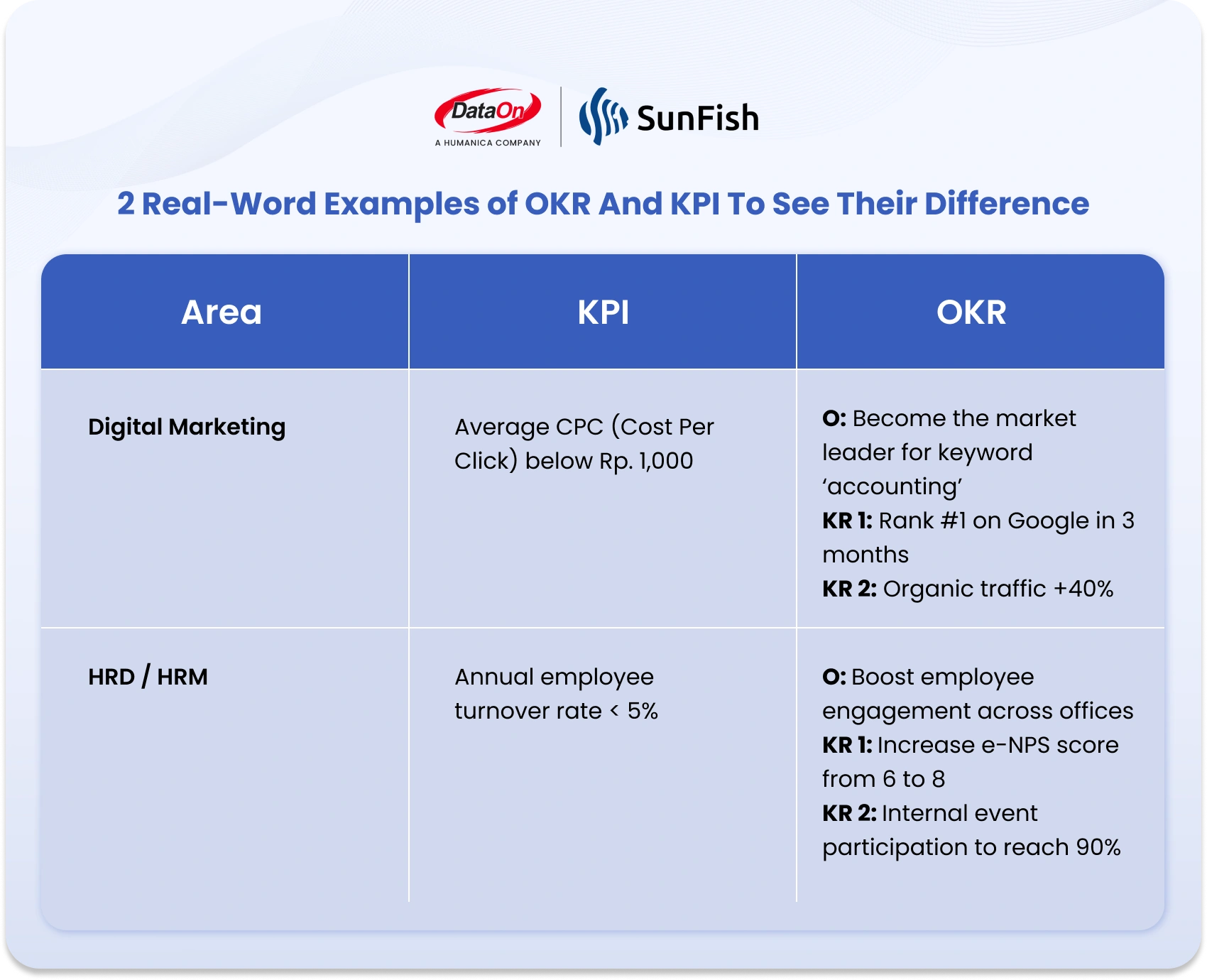
Key Performance Indicators (KPIs) exist to answer a straightforward question: is the organization operating as expected today? They focus on stability, reliability, and consistency. KPIs are typically tied to ongoing processes such as payroll accuracy, system uptime, time-to-hire, absenteeism rates, or service levels. When KPIs move unexpectedly, they signal operational risk and prompt corrective action. Their value lies in monitoring health, not in driving change.
Objectives and Key Results (OKRs), by contrast, were created to address a different challenge: alignment and change. OKRs are not about maintaining performance but about directing effort toward new priorities. An objective articulates a desired outcome, while key results define how progress toward that outcome will be measured. OKRs are intentionally forward-looking and often time-bound, typically set quarterly. Where KPIs ask whether the engine is running smoothly, OKRs ask where the organization wants to go next — and what must improve to get there.
The tension many organizations experience is not because one framework is superior to the other, but because they attempt to use both tools for the same purpose. When KPIs are treated as strategy, they feel limiting. When OKRs are treated as performance controls, they feel unstable. Understanding the distinction between monitoring stability and driving change is the first step toward using either tool effectively.
2.1. What KPIs Are Designed to Do Well
Key Performance Indicators (KPIs) are one of the most widely used management tools for a reason. When applied in the right context, they provide clarity, consistency, and focus.
KPIs work particularly well when:
- Work is operational or repetitive in nature
- Success can be measured reliably and consistently
- Stability, accuracy, and efficiency matter more than experimentation
- Leadership needs predictable reporting and trend analysis
Examples include payroll accuracy, service-level compliance, operational uptime, or cost control. In these situations, KPIs help teams understand whether processes are running as expected and where corrective action may be needed.
However, KPIs are less effective when teams are asked to navigate change, explore new ways of working, or align across functions on emerging priorities. They tend to reinforce existing processes rather than challenge them.
This does not make KPIs “wrong”—it simply defines where they are most useful.
2.2. What OKRs Are Designed to Do Well
Objectives and Key Results (OKRs) are often associated with growth, transformation, and innovation. At their best, they help organizations articulate direction, focus effort, and align teams around shared outcomes.
OKRs are particularly useful when:
- Direction matters more than precision
- Teams are working toward change or improvement
- Collaboration across departments is required
- Learning and adjustment are expected throughout the year
They are well suited to situations where outcomes are not yet fully known, and where progress must be reviewed regularly rather than reported retrospectively.
At the same time, OKRs place higher demands on management discipline. They require clear ownership, frequent check-ins, and a willingness to discuss progress openly. When treated as a once-a-year documentation exercise, they quickly lose their value. In practice, OKRs do not replace management—they make the presence or absence of it more visible.

3. Why “OKRs vs KPIs” Misses the Point
Discussions around KPIs and OKRs often frame them as competing frameworks, as if organizations must choose one and discard the other. In practice, this framing creates more confusion than clarity. The real challenge is not selecting the “right” framework, but understanding what kind of work teams are being asked to perform — and choosing tools that match that reality.
Organizations rarely operate in a single mode. Most manage a combination of stable operations, continuous improvement, and strategic change at the same time. Payroll must run accurately every month. Customer response times must remain consistent. At the same time, leadership may expect faster hiring, new digital capabilities, or improved productivity across functions. When these different expectations are not clearly distinguished, goal-setting becomes confusing. Teams are asked to innovate while being measured as if stability were the only priority. Or they are evaluated on aspirational goals without the operational discipline needed to sustain them.
This is where the “KPIs versus OKRs” framing becomes misleading. The more useful question is: what is this team primarily accountable for right now? Maintaining reliable execution? Improving an existing process? Or delivering a specific change within a defined time frame?
3.1. When Should You Use KPI or OKR?
KPIs and OKRs are designed for different situations, and their effectiveness depends largely on context. Problems arise when these tools are applied outside their natural use cases. KPIs can feel restrictive when teams are asked to innovate. OKRs can feel unstable when used to manage routine operations. Understanding whether a team is primarily maintaining performance or driving change is the key determinant in choosing the right framework.
Use KPIs when: the priority is operational reliability. KPIs work well when you need to monitor critical core business functions (e.g. server uptime, production defect rates, legal compliance) where outcomes are predictable, and consistency matters. In these cases, success is defined by stability and control.
Use OKRs when: the priority is changing the market. OKRs work well when teams launch new products, enter a new market or must improve a capability, and align behavior around a new direction. In cases where agility is needed (e.g. startups, innovation), OKRs help clarify priorities when outcomes are not yet stable and experimentation is required.
KPIs and OKRs are not competing philosophies. They are complementary tools that serve different phases of work. Choosing between them without understanding that distinction often leads to frustration — not because the tools fail, but because they are asked to solve the wrong problem.
3.2. Do You Need Both? The Synergy of KPI And OKR?
In practice, many organizations need both KPIs and OKRs — but for different reasons and at different levels.
KPIs protect the organization’s operational foundation. They ensure that essential processes continue to function reliably while change is happening elsewhere. OKRs, meanwhile, provide direction and momentum, helping teams focus on what must improve or evolve next. To visualize this synergy, imagine KPIs as the ‘engine’ that ensures business runs smoothly, while OKRs act as a ‘turbo boost’ for acceleration.
Used together, the two frameworks create balance. KPIs establish a baseline of expected performance, while OKRs define where effort should be concentrated beyond that baseline. This combination allows organizations to pursue improvement without losing control of day-to-day operations.
KPI – OKR Synergy Example:
The Customer Service team uses a KPI to keep response time under 30 minutes, but uses an OKR to launch a new agent training program aimed at increasing the customer satisfaction score to 95% in one quarter.
4. A Practical Way to Decide What Your Team Needs This Year
Once teams understand the difference between KPIs and OKRs, the next challenge is to choose the appropriate framework, which is the one the organization can realistically sustain. A productive starting point is to step away from labels and ask a small set of foundational questions about how work actually happens today.
Question 1 – Is the work primarily about maintaining performance or changing it?
Teams responsible for keeping operations stable — payroll accuracy, service levels, compliance, system uptime — usually benefit from clear, consistent measures that do not change frequently. In these cases, KPIs often provide the structure teams need. By contrast, teams tasked with transformation, growth, or improvement — entering new markets, redesigning processes, or building new capabilities — often require goals that are more directional and adaptive. This is where OKRs can help create focus and momentum.
Question 2 – Is success already well defined, or still being discovered?
When outcomes are known and repeatable, it makes sense to measure and optimize them. When outcomes are uncertain or evolving, teams need space to learn, adjust, and refine their understanding of what “good” looks like. Expecting precision too early can limit progress rather than accelerate it.
Question 3 – Do managers review progress actively throughout the year, or only discussed at formal intervals.
Frameworks that rely on continuous feedback and adjustment require managers who are present, engaged, and comfortable having regular performance conversations. Without that habit, even well-designed OKRs can quickly lose relevance.
Question 4 – Is alignment across teams a recurring challenge?
Alignment challenges offer another signal. If cross-team coordination is a recurring issue, goals may need to emphasize shared outcomes rather than isolated metrics. In these environments, the visibility and transparency of objectives matter as much as the objectives themselves. Conversely, in more independent teams, simpler goal structures may be sufficient.
Question 5 – Is data availability strong, or still developing?
Finally, teams should be honest about data availability and reliability. Some organizations have strong, trusted data that supports regular measurement. Others are still building that foundation. Choosing an approach that assumes high data maturity before it exists often leads to frustration and loss of confidence in the system.
When viewed together, these questions tend to narrow the options significantly. They help teams choose an approach that supports execution rather than adds complexity. Most importantly, this lens reframes the conversation. Instead of asking “What framework should we adopt?” organizations begin asking “What can we reliably run, review, and improve this year?”
That shift alone often makes goal-setting more effective — regardless of whether the answer is KPIs, OKRs, a combination of both, or a phased approach over time.
5. Where Teams Often Get Stuck — Even with the Right Framework
Even when teams understand the difference between KPIs and OKRs, and even when they select an approach that seems appropriate, planning can still break down in predictable ways. These mistakes are rarely about intent or effort. More often, they emerge when frameworks are applied mechanically rather than thoughtfully. Here are five of the most common mistakes teams make and how to avoid them:
Mistake 1: Treating frameworks as the starting point instead of the outcome.
When teams begin planning by asking whether they should use KPIs or OKRs, they often skip the more important conversation about what kind of work lies ahead. As discussed earlier, maintaining performance and driving change require different types of focus.
How to Avoid: Start with discussing the problem rather than the tools to guarantee alignment.
Mistake 2: Overloading teams with goals.
In an effort to be thorough, organizations sometimes convert every responsibility into a formal objective. The result is not clarity, but dilution. KPIs lose their signal value, OKRs lose their sense of priority, and teams struggle to distinguish what truly matters from what is merely tracked.
How to Avoid: Prioritize the most critical, actionable goals (3-5) and use clear, precise words in formulating targets. Be specific with numbers and ownership assignment to ensure accountability and progress tracking.
Mistake No. 3: Confusing measurement with management
Metrics alone do not create alignment or accountability. Without regular review, discussion, and adjustment, even well-defined goals become static documents. As highlighted in earlier sections, goal-setting frameworks only work when managers actively engage with progress throughout the year — not just during planning or appraisal cycles.
How to Avoid: Revisit targets frequently and when company strategy changes to ensure they reflect current priorities.
Mistake No. 4: Assuming a level of data maturity that does not yet exist.
Precision can be valuable, but premature precision often undermines credibility. When targets are set using unreliable or incomplete data, conversations quickly shift from improvement to debate.
How to Avoid: If this is the case, simplify indicators or directional goals for better effectiveness until data quality improves.
Mistake No. 5: Inconsistent execution across teams.
When different departments interpret frameworks differently, alignment suffers. What is intended as a shared planning language becomes fragmented.
How to Avoid: Make clarity around intent, cadence, and expectations just as much a priority as the framework itself.
Taken together, these mistakes reinforce a central theme of this guide: effective planning is less about choosing the “right” methodology and more about ensuring that goals, management habits, and organizational maturity are in sync. When that alignment exists, frameworks become enablers rather than obstacles — and planning shifts from an annual exercise to a meaningful driver of execution.

6. Choosing What Will Still Work in March — Not What Sounds Right
Planning frameworks are easy to adopt on paper. Sustaining them through the year is far harder. The most effective planning approach is rarely the most sophisticated one. It is the one managers understand, teams can work with, and leadership continues to support when attention shifts elsewhere. KPIs and OKRs are both powerful tools — but only when they are used to solve the right problem, at the right level, with the right expectations.
As the planning season continues, organizations would benefit from shifting the conversation away from ‘what should we adopt’ toward ‘what can we realistically execute’. That distinction often determines whether planning becomes a useful discipline or another administrative cycle.
The best planning system is the one your teams are still using in March — not just submitting in January.