







In our previous article, From HR Automation to Human-Centered AI, we explained the difference between automation and AI and offered a simple definition: human-centered AI is AI designed around the people who use it and the people affected by its results.
A definition is a good start, but it does not tell you what it means for your day-to-day work. What does human-centered AI actually change in the way HR works? Which principles should guide the tools you choose? And what does it ask of HR leaders themselves?
To answer those questions, we start with something that shapes every AI choice you make: why AI needs more care in HR than in most other parts of the business. From there, we walk through five principles that turn the idea into everyday practice, and look at how your own role shifts as AI becomes part of the team.
Why AI needs more care in HR
AI is being used everywhere, from marketing to logistics. But a tool that works well for a marketing team can do real harm if it is used carelessly in HR. Three things make your work different, and each one shapes how you should approach AI.
-

HR decisions land on people.
When AI recommends the wrong product to a customer, the cost is a lost sale. When it ranks a job applicant too low, misreads someone’s performance or contributes to a payroll error, the cost is a missed career step, a damaged relationship or an employee who cannot pay their rent on time. The stakes are personal.
-
HR data is among the most sensitive data a company holds.
Salaries, family details, health-related leave, performance ratings and disciplinary records all sit in the HR system. Regulations such as Indonesia’s Personal Data Protection Law (UU PDP) make clear that this information must be handled with care, and employees expect the same.
-
HR runs on trust.
Employees bring their questions, complaints and personal situations to HR because they believe they will be treated fairly. If AI is introduced in a way that feels opaque or careless, that trust can be lost quickly, and it is very hard to win back.


Taken together, these three points set a high standard. Any AI you use in HR needs to treat people fairly, keep their personal data safe and earn their trust. That is why “human-centered” is not a nice extra for HR. It is the condition for using AI at all. The real question is how to meet that standard consistently, tool after tool, rather than deciding case by case.
Five principles of human-centered AI in HR
This is where principles help. Think of them as a simple checklist. Whenever you look at a new AI tool, no matter which company makes it, you can ask: does it follow these principles? Each of the five below deals with at least one of the concerns above: protecting the people affected, handling their data with care, or keeping their trust.

1. Strengthen expertise, don’t replace it
Good AI makes skilled people faster and sharper. It does not quietly take over their judgment. Take recruitment. An AI tool can read hundreds of applications and show how closely each one matches the role, which saves recruiters hours of screening. But a match score only reflects what is written on paper. It cannot see potential, motivation or how someone might grow into a team. The recruiter uses the score to focus attention, then makes the call.
2. Show the reasoning and the source
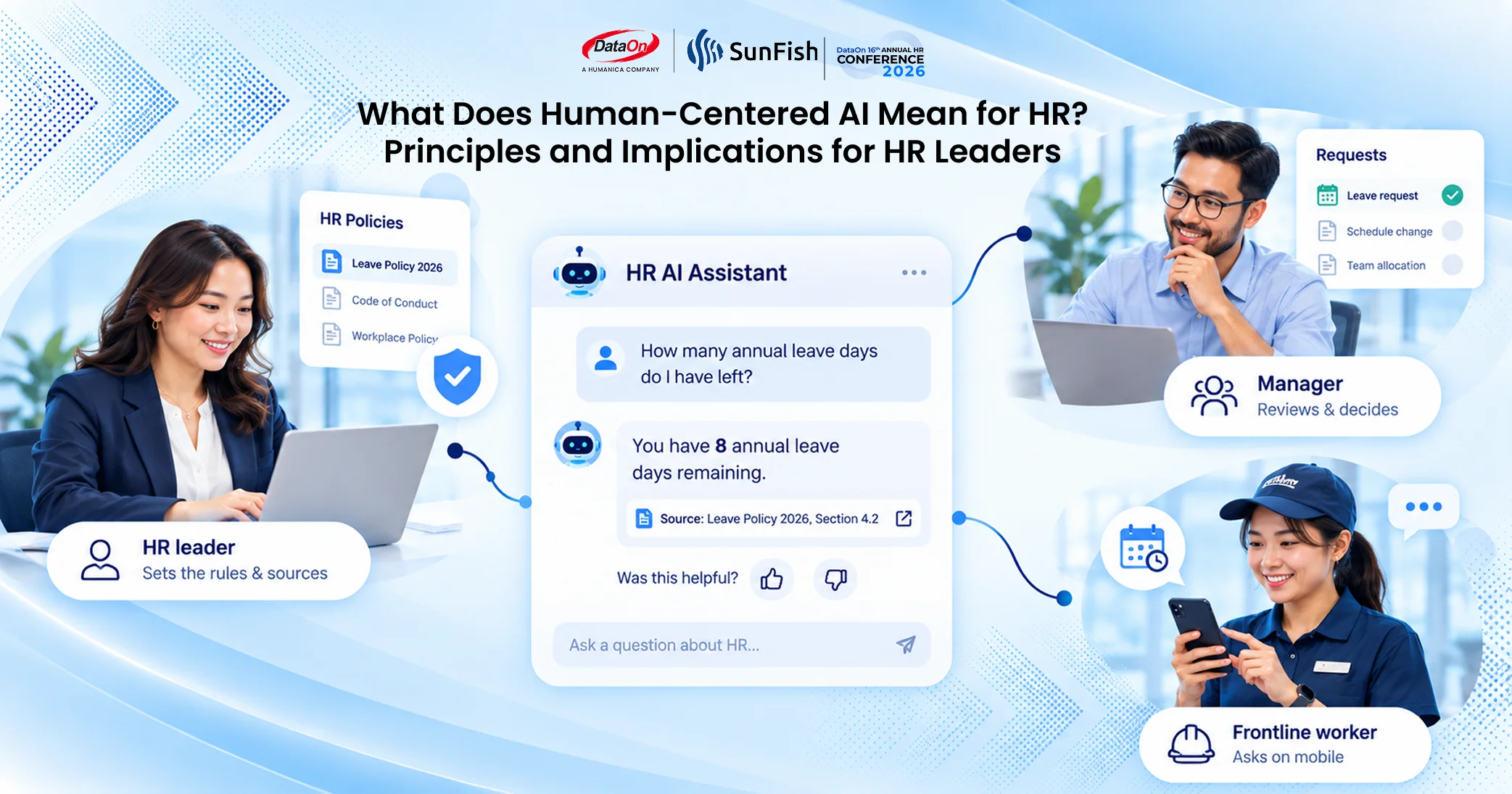
People trust answers they can check. When an employee asks an HR assistant about their maternity leave entitlement, the answer should come from the company’s own policy, not from general information on the internet, and it should be clear where it came from. In-app assistants such as SunFish Intelligence draw on the company’s own documents, FAQs and help content for exactly this reason. HR stays in control of the source of truth.
3. Be fair by design
AI learns from historical data, and historical data can carry old habits. If past promotions favored one group, a model trained on them may quietly repeat the pattern. Human-centered AI means asking early: what data is this trained on, and does it treat different groups of employees equally? It also means checking the results regularly, not just once at launch.
4. Work for every employee, not just the office
In many organizations, the largest groups of employees work in stores, factories, hotels or on the road, not at a desk. AI that only works well for confident laptop users leaves them behind. Human-centered AI uses plain language, works on mobile and handles simple questions simply, so that a shift worker can check their schedule as easily as a manager can analyze a report.
5. Keep learning from the people who use it
No AI is perfect on day one. What matters is whether it improves. That requires a feedback loop: employees can rate answers, HR can see where the tool struggles, and someone is responsible for fixing it. In SunFish, for example, users can give a thumbs up or down on each assistant response, and administrators can track conversations, feedback and success rates in a central dashboard. Small mechanisms like these turn AI from a one-time installation into a service that keeps getting better.
Put simply, the five principles describe AI that works alongside people. It supports their judgment, shows where its answers come from, treats everyone fairly, reaches every employee and keeps improving through their feedback. You will notice that none of them is really about the technology. They are all about how AI fits into the way people work.
How your role shifts as AI joins the team
If the principles are about how AI fits into the way people work, someone has to make that fit happen. A tool can show its sources and collect feedback. But it cannot decide which sources are correct, check its own results for fairness or act on what employees tell it. In most organizations, that job falls to HR.
This brings us back to the question we asked at the start: what does human-centered AI ask of HR leaders themselves? The answer is that your tools are not the only thing that changes. Your role changes too. Four shifts stand out.

From data entry to data stewardship.
AI is only as good as the data behind it. Outdated job titles, missing reporting lines or inconsistent leave records will lead to poor answers and poor suggestions. Keeping core HR data clean used to be an administrative task. Now it directly affects the quality of every AI insight.
From using tools to governing them.
Someone needs to decide which AI tools are approved, what they may access, which decisions always need a person, and how problems are escalated. HR does not have to do this alone, but it should have a strong voice alongside IT, legal and data protection teams. After all, HR understands the people impact better than anyone.
From training on systems to building AI literacy.
HR teams and managers need to know what AI is good at, where it makes mistakes and when to question it. This is less about technical knowledge and more about healthy judgment, like knowing when a confident-sounding answer deserves a second look.
From announcing change to explaining it.
Employees will have questions. Is AI evaluating me? Who can see my data? Will it replace my job? Clear, honest communication about what AI does and does not do is one of the most effective ways to build acceptance.
None of these shifts asks you to become a technology expert. They ask you to do what HR has always done, which is to look after people, their data and their trust, only now with AI as part of the picture.
Why these questions matter now
It is worth being honest about where things stand. In most organizations, AI in HR is still at an early stage. Many HR systems now include an AI assistant of some kind, but few HR teams rely on AI for real decisions yet. For many leaders, AI is something they want to know is available, rather than something they use every day.
So why think about it now? Because the question is starting to change from “Do we have AI?” to “What does it actually do for our people’s performance?” Think of the everyday moments where time and attention slip away: a manager spending two days building next month’s roster, an HR team answering the same leave questions every week, a payroll review that depends on one person noticing what changed. These are exactly the places where AI can help most.
But that help only turns into better performance if people use the tool and trust what it tells them. A roster suggestion that managers don’t trust gets rebuilt by hand. An assistant that gives unclear answers gets ignored, and the questions land back on HR’s desk. This is where the five principles become very practical. They are what turns AI from something a company has into something that really helps its people work better.
Looking ahead
Human-centered AI in HR comes down to a simple promise: technology takes on more of the work, while people stay responsible for the outcomes that matter to other people. The five principles describe what that promise looks like, and the shifts in HR’s role show who keeps it.
Of course, the hardest part is often deciding where exactly to draw the line between AI and human judgment. That is the topic of our next article, where we share practical guidance on how HR can balance AI and human decision-making.
Want to explore these questions with other HR leaders? Join us at the DataOn 16th Annual HR Conference 2026, “Accelerating Workforce Performance with Human-Centered AI,” on Thursday, 5 November 2026 at the Sheraton Grand Jakarta Gandaria City Hotel. Register here.