







The manufacturing industry depends on workforce coordination that moves in step with production. For this reason, HR management goes beyond employee administration to ensure that workforce capacity, skills, schedules, productivity, and HR policies can support operational requirements.
Its role becomes increasingly strategic as manufacturing moves toward more digital operations. The Deloitte 2025 Manufacturing Industry Outlook reported that US manufacturing employment remained stable at around 13 million workers in 2024, while 98% of 800 surveyed manufacturers had begun their digital transformation journey, up from 78% in 2019.
This complexity gives HR management in manufacturing its own distinct characteristics and requires HR to become more closely connected with business operations.
What Is HR Management in the Manufacturing Industry?
HR management encompasses a range of activities to plan, acquire, develop, manage, and retain the workforce in alignment with organizational needs. In a manufacturing environment, these functions must adapt to operational characteristics shaped by production capacity, work schedules, locations, skills, and changing demand.
In other words, manufacturing HR sits at the intersection of people and operations. Decisions related to staffing, attendance, skills, or workforce deployment can directly affect a facility’s ability to execute its production plans.
Why Is HR an Important Part of Manufacturing Operations?
Manufacturing facilities need the right number of people with the right skills at the right time to maintain operational continuity. A workforce shortage in just one function can create capacity imbalances even when machinery, materials, and technology are readily available.
This relationship becomes even more relevant in smart manufacturing. The Deloitte 2025 Smart Manufacturing and Operations Survey found that 92% of 600 manufacturing executives surveyed believe smart manufacturing will be the primary driver of competitiveness over the next three years, yet human capital had the lowest maturity level among the categories assessed.
Why Is HR Management in Manufacturing More Complex?
Manufacturing workforce complexity arises because HR requirements must continuously adapt to changing operational conditions. A single organization may operate multiple plants, employ thousands of workers, run different shift patterns, require specialized skills, and enforce policies consistently across its operations.
These challenges mean HR in manufacturing cannot be managed solely as an administrative function. HR needs visibility into workforce conditions as well as the ability to connect workforce decisions with operational requirements.
1. Operations Run Across Multiple Shifts and Locations
Manufacturing facilities may operate beyond conventional office hours through multiple continuous shifts. HR must ensure that every shift has sufficient capacity without creating workload imbalances, excessive overtime, or staffing shortages.
Complexity increases for organizations operating multiple plants because workforce requirements may differ across locations. Manpower planning therefore needs to account for the actual needs of each facility while considering the production targets that must be achieved.
Read Also: 40% of Working Hours Wasted: Solutions for Companies to Overcome Unproductive Activities
2. Workforce Availability Is Linked to Production Targets
Labor shortages are not merely a recruitment issue because their impact can extend directly to the production line. The UKG Workforce Institute 2024 Manufacturing Talent Trends Report found that 31% of production lines remained understaffed in 2024, while 40% of manufacturers experienced production delays at least once a week.
The same survey found that 69% of respondents said labor shortages affected their ability to meet production demands. These findings demonstrate why workforce planning needs to be part of operational capacity discussions rather than treated as a standalone HR decision.
3. Skill Requirements Evolve Alongside Production Technology
Automation, analytics, artificial intelligence, and connected production systems are changing the skills required across the manufacturing industry. HR must map existing capabilities while determining when the organization needs to recruit, train, reskill, or redeploy talent.
The challenge is also evident in recruitment. Deloitte reported that 48% of respondents experienced moderate to significant difficulty filling production and operations management roles, while 46% faced similar challenges in planning and scheduling.
Read Also: Upskilling and Reskilling in Indonesia: Building Workforce Resilience for 2026 and Beyond
4. Attendance and Working Hours Involve Multiple Variables
Time tracking in manufacturing can involve shifts, rotations, overtime, lateness, leave, schedule changes, and different rules across locations. A change in any of these variables can affect both staffing and compensation calculations.
HR therefore needs scheduling, attendance, and payroll to work together. Fragmented information makes reconciliation more time-consuming while limiting the team’s ability to gain an up-to-date view of workforce conditions.
5. Turnover Can Disrupt Operational Stability
Employee turnover has broader consequences when a position requires specific experience or skills. Organizations need to repeat recruitment, onboarding, training, and adjustment processes before a replacement reaches the required level of productivity.
UKG found that 42% of manufacturers reported higher turnover than the previous year. The study also showed that 28% of new-hire turnover occurred within the first 30 days and another 20% between days 30 and 60, making the early employee experience an important area for HR attention.

Key HR Challenges in the Manufacturing Industry
HR challenges extend beyond workforce availability because factory transformation is also changing how organizations manage their workforce. Deloitte found that 65% of executives ranked operational risk as their first or second priority to mitigate when implementing smart manufacturing.
These findings reinforce the need to align HR strategies with operational change. Technology transformation without workforce readiness can create a new gap between what systems are capable of doing and the people responsible for operating them.
1. Aligning Workforce Planning with Production Needs
Workforce requirements can fluctuate based on order volumes, facility capacity, production cycles, absenteeism, or schedule changes. Planning based solely on headcount is not enough to determine whether each function has people with the capabilities it requires.
HR needs to approach manpower planning based on positions, skills, locations, shifts, and capacity requirements. This approach helps organizations anticipate workforce shortages before they begin affecting production activities.
Read Also: Latest Employment Regulations 2026: Updates on Wages, BPJS, and Severance Pay
2. Retaining the Frontline Workforce
Frontline employees experience working conditions that differ from those of office employees, from shift patterns and physical demands to the need for greater flexibility. A poor employee experience can increase the risk of absenteeism and workforce turnover.
UKG found that 73% of manufacturers acknowledged that frontline employees wanted more flexibility than they currently provided. However, only 42% of respondents offered flexible scheduling, while 54% provided predictable work schedules.
3. Closing Skill Gaps
New technology does not automatically improve productivity if employees are not equipped to use it. HR needs visibility into existing competencies, gaps in critical roles, and learning requirements as technology continues to evolve.
These gaps remain evident in smart manufacturing. Only 48% of respondents in Deloitte’s survey reported having smart manufacturing training and adoption standards, while human capital recorded the lowest maturity level among the categories assessed.
Read Also: Closing Skill Gaps in Indonesia: Upskilling, Reskilling, and Organizational Capability
4. Maintaining Compliance Amid Operational Complexity
Working hours, overtime arrangements, payroll, occupational safety, social security, and employment relationships must comply with applicable regulations. Complexity increases when organizations operate across multiple locations or apply different operational policies, as is often the case with HR management for multi-entity companies.
HR needs controls that ensure policies are implemented consistently without removing the flexibility each facility requires. Centralized documentation and information can also simplify audits and make historical records easier to trace when needed.
Read Also: How to Choose HR Software for a Multi-Company Organization
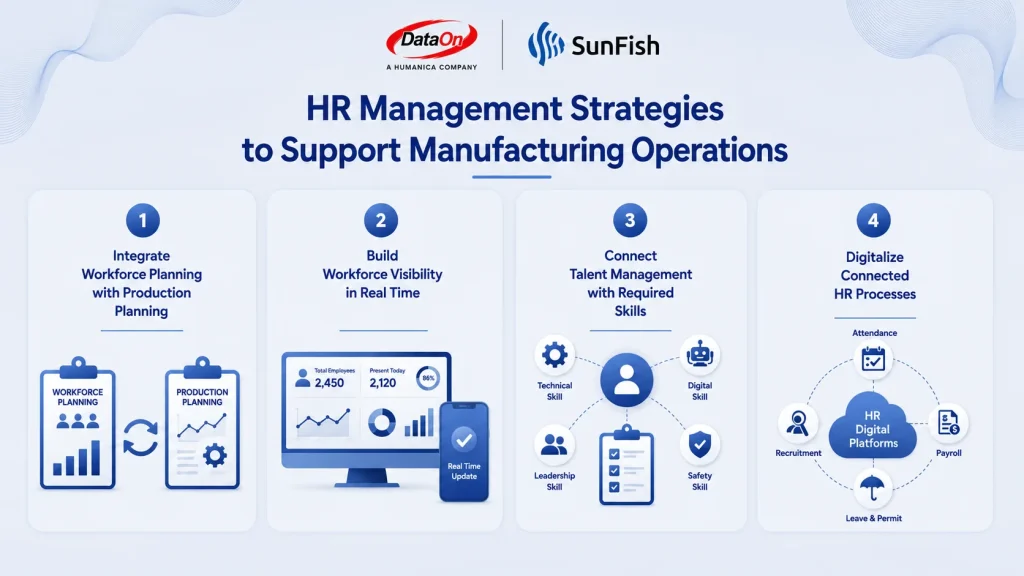
HR Management Strategies to Support Manufacturing Operations
Digital transformation across the manufacturing industry shows that technology investment is increasingly becoming part of operational strategy. Deloitte reported that technology investment reached approximately 30% of operating budgets in 2024, up from 23% in 2023.
However, greater technology investment needs to be accompanied by workforce readiness. An effective HR management strategy should connect workforce planning, skill development, frontline employee experience, and HR information within a unified operational framework.
1. Integrate Workforce Planning with Production Planning
HR and operations need to use aligned workforce assumptions when planning capacity. Production forecasts can be translated into headcount, skill, shift, and location requirements, allowing organizations to respond more quickly to changes in demand.
This collaboration also helps HR distinguish temporary workforce shortages from structural requirements. Decisions involving overtime, recruitment, cross-training, or workforce redistribution can then be based on more measurable operational needs.
2. Build Real-Time Workforce Visibility
Headcount alone is not enough to represent workforce conditions within a manufacturing organization. HR needs to know who is available, which shifts they are assigned to, what skills they have, and how attendance and turnover trends are developing.
Workforce dashboards can help HR and operations identify these patterns without waiting for manual data consolidation. Shared visibility also reduces information gaps when decisions involve multiple plants or functions.
3. Connect Talent Management with Required Skills
Talent management needs to reflect changing organizational capabilities rather than operate solely around annual performance cycles. Competency mapping helps HR identify critical positions, internal candidates, training requirements, and potential succession gaps.
This approach becomes particularly important when new skills emerge faster than the labor market can supply them. Organizations can combine recruitment, cross-training, reskilling, and internal development to expand their available talent pool.
4. Digitalize Connected HR Processes
HR digitalization should not result in a collection of applications operating independently. Attendance, scheduling, payroll, recruitment, performance, training, and talent management should use interconnected workforce information so that changes in one process can flow into related processes.
This principle aligns with the direction of manufacturing transformation, which increasingly relies on system and data integration. Deloitte reported that 98% of 800 manufacturers in its 2023 Digital Maturity Index Survey had begun their digital transformation journey, compared with 78% in 2019.
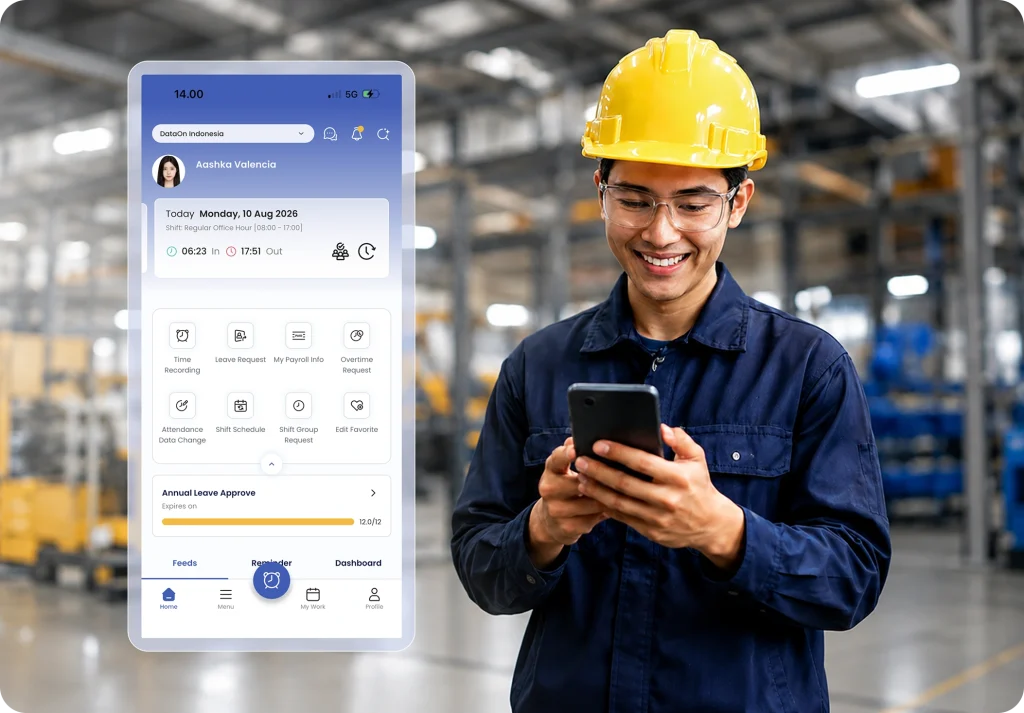
Integrate Manufacturing HR Management with SunFish HR
HR management in the manufacturing industry requires strong connections between workforce planning, HR administration, and operational requirements. When workforce information is fragmented across multiple systems, HR has less visibility to support effective planning and decision-making.
As an integrated HR solution for the manufacturing industry, SunFish HR helps bring workforce management together on a single platform. Employee data, time and attendance, payroll, manpower planning, recruitment, and talent management can be managed through connected processes designed to support complex workforce requirements.
With more integrated workforce information, HR and operations can work from a shared foundation to manage employees while supporting operational continuity. Discover how SunFish HR can help manufacturing companies build more connected and scalable HR management, and contact the DataOn Professional Team to discuss your company’s HRIS and payroll requirements.
FAQ
What does HR management include?
HR management includes workforce planning, recruitment, onboarding, time and attendance management, compensation, performance management, training, talent development, employee relations, retention, and offboarding. In manufacturing, these functions also need to align with production requirements, shifts, workforce skills, and the capacity of each facility.
What is manufacturing management?
Manufacturing management is the coordination of resources and production activities to ensure goods are produced according to quality, cost, time, and capacity targets. Its scope can include production planning, workforce management, materials, machinery, quality, maintenance, and operational coordination.
What does the manufacturing industry include?
The manufacturing industry encompasses activities that transform raw materials or components into finished or intermediate goods through production processes. It includes sectors such as food and beverage, textiles, automotive, electronics, chemicals, pharmaceuticals, metals, machinery, consumer goods, and other processing industries.
What are five examples of human resources?
Five examples of human resources in a manufacturing context are production operators, maintenance technicians, quality control personnel, production supervisors, and production planners. Each role requires different capabilities while contributing collectively to production continuity.